

When miners compare hardware, the first numbers they look at are usually hashrate and watts.
But true efficiency is not just a specification on a product sheet.
At IceRiver EU, efficiency is treated as an engineering outcome — the result of airflow design, internal layout optimization, and long-term thermal stability.
Because in real-world mining, sustainable performance is built through design — not just advertised specs.
Efficiency on Paper vs Efficiency in Practice
Most miners evaluate efficiency using:
- TH/s or GH/s
- Power consumption (W)
- Watts per TH
These numbers matter — but they don’t tell the full story.
Two miners with identical hashrate and wattage can perform very differently over time depending on:
- Internal airflow path
- Component spacing
- Heat distribution
- Power delivery stability
Efficiency that only exists in lab conditions is not real efficiency.
Airflow: The Foundation of Sustained Performance
Cooling isn’t just about adding powerful fans.
It’s about how air moves through the miner.
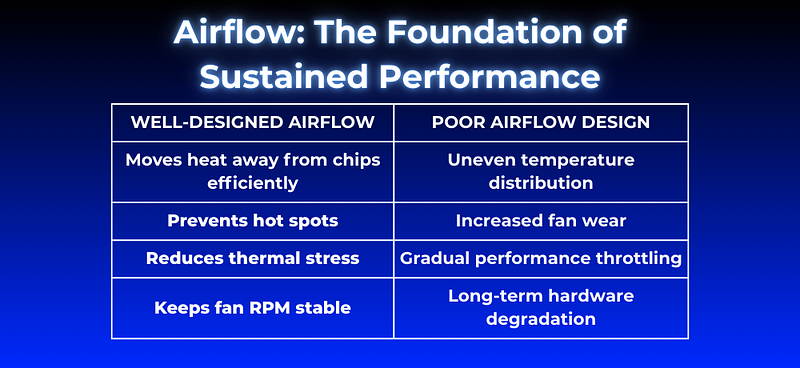
IceRiver EU miners are engineered with directed airflow channels to ensure consistent heat dissipation under 24/7 load.
👉 Explore IceRiver EU miner lineup:
https://www.iceriver.eu/collections/iceriver-miners
Internal Layout: Spacing Matters More Than You Think
Component placement directly affects efficiency.
Optimized internal layouts:
- Maintain balanced airflow pressure
- Reduce thermal clustering
- Improve long-term chip stability
Overcrowded layouts may achieve high initial performance, but they increase heat density — which accelerates degradation.
True efficiency is about thermal balance, not peak output.
Thermal Stability Over Time
Short-term efficiency spikes are easy to achieve.
Long-term thermal stability is harder.
As miners run continuously:
- Heat accumulates
- Dust reduces airflow
- Ambient conditions change
Designs that prioritize stability can maintain predictable performance even as conditions evolve.
This is why IceRiver EU emphasizes sustained thermal control rather than aggressive short-term tuning.
Power Delivery and Efficiency
Efficiency isn’t just about airflow.
Stable power delivery:
- Reduces voltage spikes
- Minimizes electrical stress
- Supports consistent hashrate
- Extends hardware lifespan
Miners operating at unstable voltage may still hit advertised specs — but at the cost of long-term reliability.
Engineering efficiency means designing for continuous stability, not peak bursts.
Spec Sheet Efficiency vs Engineered Efficiency
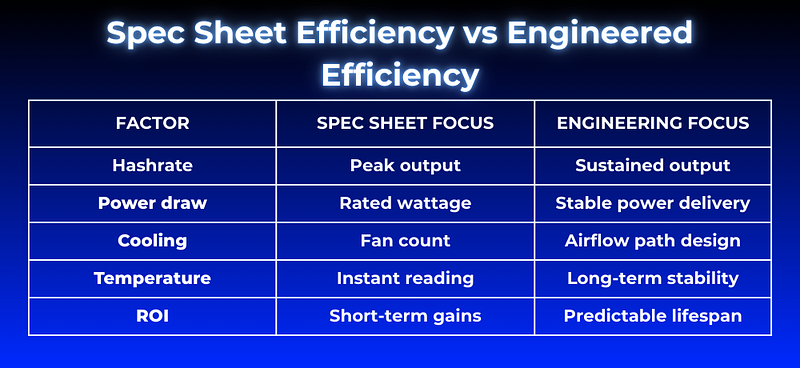
Numbers attract attention. Engineering preserves profitability.
Why Design-Based Efficiency Protects ROI
Efficient engineering reduces:
- Downtime
- Maintenance costs
- Unexpected throttling
- Component wear
This translates to:
- Higher uptime
- More consistent net profit
- Longer hardware lifecycle
Efficiency that lasts over years is more valuable than efficiency that peaks for weeks.
Efficiency in Hosting Environments
Professional hosting environments amplify design advantages.
Controlled airflow, proper spacing, and stable power infrastructure enhance:
- Thermal performance
- Reliability
- Hardware longevity
👉 Learn about IceRiver EU hosting:
https://www.iceriver.eu/pages/hosting
When miner design and hosting conditions align, efficiency becomes sustainable.
The Bigger Picture
As mining matures:
- Difficulty increases
- Margins tighten
- Inefficient hardware gets phased out
Miners built around thoughtful engineering adapt better to long-term market changes.
Efficiency becomes less about chasing the highest hashrate and more about preserving predictable output.
Conclusion
Miner efficiency is not just about numbers on a spec sheet.
It is the result of:
- Airflow engineering
- Internal layout optimization
- Thermal balance
- Stable power systems
At IceRiver EU, efficiency is designed into the hardware from the inside out.
Because in long-term mining, engineering matters more than marketing.