

In crypto mining, the phrase “overloading a miner” is often misunderstood. At IceRiver EU, miner design and hosting practices are built specifically to avoid these risks. Here’s what overloading really means and how miners can prevent it.
Many miners think it simply means pushing hashrate higher. Others assume it only refers to plugging a miner into the wrong power outlet. In reality, overloading is a combination of electrical, thermal, firmware, and environmental stress that can quietly damage hardware and reduce long-term profitability.
👉 Explore IceRiver EU ASIC miners:
https://www.iceriver.eu/collections/iceriver-miners
What Does Overloading a Miner Actually Mean?
Overloading a miner occurs when the hardware is forced to operate outside its safe operating limits for extended periods.
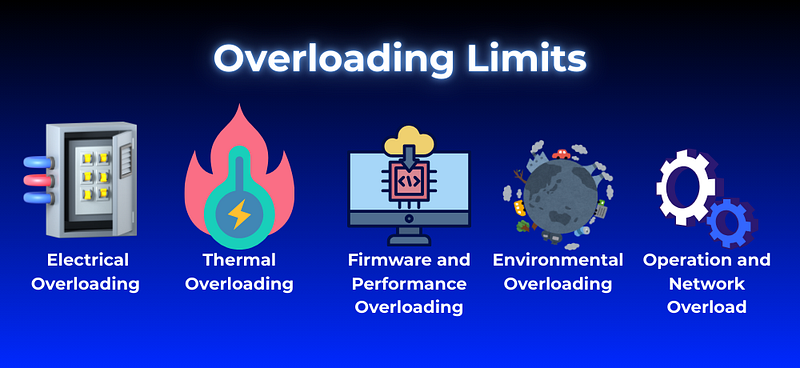
Overloading rarely causes instant failure. Instead, it leads to instability, downtime, degraded performance, and shortened hardware lifespan.
1. Electrical Overloading
What Causes Electrical Overload
Electrical overloading happens when:
- Power circuits are undersized
- Power supplies run near or beyond rated capacity
- Cables and connectors overheat
- Voltage becomes unstable
ASIC miners draw continuous, high power, unlike most household devices.
Warning Signs
- Frequent reboots
- PSU overheating
- Tripped breakers
- Burnt or discolored connectors
How Iceriver EU Helps Prevent This
IceRiver EU miners are designed for stable, continuous power delivery, and IceRiver EU hosting environments use:
- Industrial-grade electrical infrastructure
- Proper circuit sizing
- Stable voltage distribution
This dramatically reduces electrical stress.
This is why many miners choose professional hosting instead of home setups, where power infrastructure may not be designed for continuous high-load operation.
👉 Learn about IceRiver EU hosting:
https://www.iceriver.eu/pages/hosting
2. Thermal Overloading (Heat Stress)
Heat is the most common cause of miner overload.
How Thermal Overload Happens
- Poor airflow
- Blocked intake or exhaust
- High ambient temperatures
- Dust buildup
When heat cannot escape efficiently, components are forced to operate above safe temperatures.
Effects of Thermal Overload
- Automatic throttling
- Sudden shutdowns
- Fan wear
- Long-term chip degradation
IceRiver EU Design Advantage
IceRiver EU miners are built with:
- Optimized airflow paths
- Balanced internal layouts
- Cooling systems designed for continuous operation
When paired with professional hosting, thermal overload risk is significantly reduced.
3. Firmware and Performance Overloading
Overloading isn’t always physical.
Firmware-Related Overload
This happens when miners:
- Use unstable firmware
- Push aggressive performance tuning
- Overclock without adequate cooling
- Ignore system error logs
Short-term gains often lead to long-term instability.
Best Practice
IceRiver EU prioritizes:
- Stable firmware operation
- Performance per watt over peak hashrate
- Predictable, long-term output
This approach reduces unnecessary hardware stress.
4. Environmental Overloading
The mining environment plays a critical role in miner health.
Environmental Risk Factors
- Dust and airborne particles
- High humidity
- Poor air quality
- Inadequate ventilation
These conditions increase fan strain, trap heat, and accelerate component wear.
Why IceRiver EU Hosting Matters
IceRiver EU hosting facilities are designed to provide:
- Clean, filtered airflow
- Controlled temperature and humidity
- Reduced dust exposure
This protects miners from environmental overload.
5. Operational and Network Overload
Operational issues can also overload miners indirectly.
Examples include:
- Unstable internet connections
- Repeated disconnections from mining pools
- Lack of monitoring and alerts
Frequent restarts and downtime increase wear and reduce effective uptime.
IceRiver EU emphasizes continuous monitoring and stable connectivity to prevent these issues.
Why Overloading Hurts Mining Profitability
Even if a miner continues running, overloading leads to:
- Reduced efficiency
- Higher downtime
- Increased maintenance costs
- Shorter miner lifespan
A miner that earns slightly more today but fails sooner is not more profitable overall.
Overloaded Miner vs Properly Managed Miner
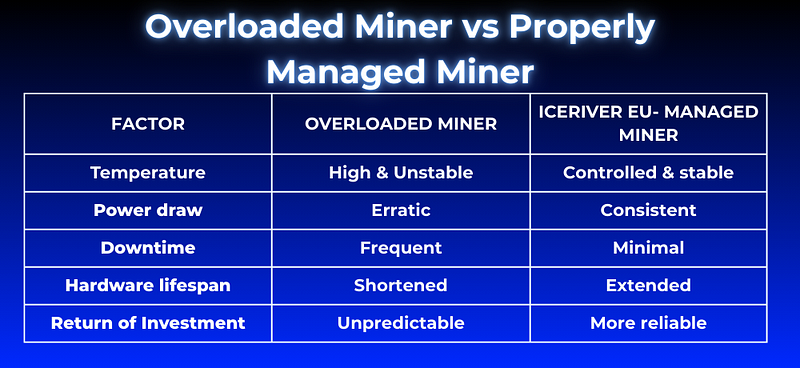
Efficiency and stability always win long term.
How IceRiver EU Prevents Miner Overload
IceRiver EU’s approach focuses on:
- Proper power infrastructure
- Efficient cooling design
- Stable firmware operation
- Clean operating environments
- Continuous monitoring
This ensures miners run within safe limits, maximizing uptime and protecting hardware investment.
Conclusion
Overloading a miner doesn’t mean it’s working better — it means it’s being stressed beyond what it was designed for.
At IceRiver EU, mining success is built on stability, efficiency, and endurance, not aggressive pushing.
By understanding what overloading really means and avoiding it, miners protect their equipment, reduce downtime, and achieve more predictable long-term profitability.
👉 Browse IceRiver EU miners and hosting solutions:
https://www.iceriver.eu/