

When considering ASIC mining, the upfront price of a miner is only part of the equation. What truly determines long-term success is how much it costs to run an Iceriver EU miner day after day.
For anyone looking at IceRiver EU miners, understanding the real operating costs — electricity, cooling, and maintenance — is essential before making a decision.
In this guide, we break down what it really costs to run an IceRiver EU miner, using simple calculations and realistic scenarios.
The Main Costs of Running an IceRiver EU Miner
Running an ASIC miner involves two categories of cost:
- Fixed cost — the miner itself
- Ongoing operating costs — mainly electricity and infrastructure
While the hardware cost is paid once, operating costs continue every single day.
1. Electricity Cost (The Biggest Factor)
Electricity is the largest ongoing expense in ASIC mining.
IceRiver EU miners are designed to be efficient, but power consumption still adds up when running 24/7.
How Electricity Cost Is Calculated
The standard formula is:
Daily kWh = (Power in Watts ÷ 1000) × 24
Daily Electricity Cost = Daily kWh × Electricity Rate ($/kWh)
Example Calculation (Typical Scenario)
Assume an IceRiver EU miner with:

- Power consumption: 3,500 W
- Electricity rate: $0.10/kWh
This is the baseline cost just to keep the miner running.
2. Cooling and Environment Costs
IceRiver EU miners are engineered with optimized airflow and thermal stability, which reduces cooling requirements compared to less efficient designs.
However, depending on where the miner runs, cooling costs may include:
- Additional fans or ventilation (home mining)
- Air conditioning
- Facility cooling fees (hosting environments)
In professional hosting facilities, cooling is typically included in the hosting rate, making costs more predictable.
👉 Learn more about IceRiver EU hosting:
https://www.iceriver.eu/hosting
3. Home Mining vs Hosting: Cost Differences
Home Mining Costs
- Residential electricity rates (often $0.10–$0.20/kWh)
- Noise and heat management
- DIY monitoring and maintenance
- Possible electrical upgrades
Hosting Costs
- Lower industrial electricity rates
- Cooling handled professionally
- Continuous monitoring
- No noise or heat at home
For many miners, hosting reduces total operating cost and operational risk, even if there is a hosting service fee.
4. Maintenance and Downtime Costs
Well-designed miners reduce hidden costs.
IceRiver EU miners focus on:
- Stable firmware
- Consistent hashrate
- Reduced thermal stress on components
This lowers:
- Unexpected downtime
- Repair costs
- Performance degradation over time
Downtime directly impacts revenue, so stability plays a major role in real operating cost.
5. What People Often Forget to Include
Many new miners underestimate costs by ignoring:
- Power supply inefficiency
- Cooling overhead
- Downtime from overheating
- Higher electricity rates during peak hours
IceRiver EU’s efficiency-focused design helps minimize these variables, but they should still be considered when planning.
Putting It All Together: Real Cost Overview
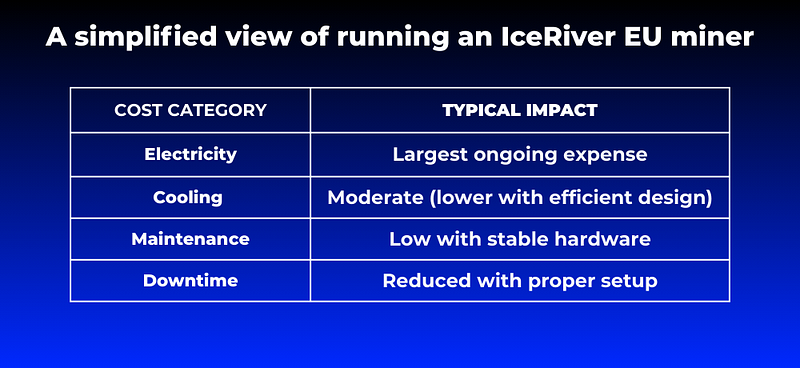
The key takeaway: Electricity cost determines whether mining stays profitable, even with efficient hardware.
Why IceRiver EU Miners Are Built for Cost Control
IceRiver EU designs its miners to:
- Deliver strong performance per watt
- Maintain stable power usage
- Operate reliably over long periods
- Reduce unnecessary heat and stress
This helps miners keep operating costs predictable and manageable over time.
👉 Explore IceRiver EU miners here:
https://www.iceriver.eu/collections/miners
Conclusion
The real cost of running an IceRiver EU miner isn’t hidden — it’s measurable.
By understanding:
- Power consumption
- Electricity rates
- Cooling needs
- Long-term stability
miners can make smarter decisions and avoid surprises.
IceRiver EU miners are built to support long-term, sustainable mining, but profitability always starts with knowing your real operating costs.
🔗 Stay Connected
📱 Instagram
📘 Facebook
🎥 YouTube
📱 TikTok
📢 Twitter